


A well-developed upper chest isn’t just about looking strong—it’s about achieving a balanced, athletic build that supports posture, strength, and movement. Many people train their chest regularly yet struggle to grow the upper portion effectively. That’s because the upper chest, or clavicular head of the pectoralis major, requires precise exercise angles and consistent technique to activate properly.
The good news is that with the right structure, you can refine your approach, activate those upper fibers more efficiently, and develop a well-rounded and aesthetically pleasing physique. This guide explains the anatomy behind upper chest training, the most effective exercises, training rules for muscle growth, and a sample weekly structure you can use to create lasting results.
Understanding the Anatomy of the Upper Chest
The Role of the Clavicular Head
The upper chest, formally known as the clavicular head of the pectoralis major, originates from the medial half of the clavicle and inserts into the humerus (upper arm bone). Its primary functions include shoulder flexion, adduction, and internal rotation—movements essential in pressing, pushing, and lifting.
When you perform exercises at an incline angle, typically between 30° and 45°, you shift the mechanical load toward this region. Over time, this targeted activation contributes to a more lifted, sculpted chest contour. A well-developed clavicular head not only enhances appearance but also improves upper body strength and shoulder stability—critical for both aesthetics and function.
The Sternal Head and Balanced Development
Just beneath lies the sternal head—the lower and larger portion of the pectoralis major, originating from the sternum. This region handles much of the work during flat or decline pressing movements, aiding in adduction and internal rotation of the shoulder joint.
Focusing exclusively on one area can lead to muscular imbalances that affect symmetry and even posture. A comprehensive chest program therefore blends incline (upper), flat (mid), and decline (lower) movements to create strength harmony across the chest. Understanding this structure helps you choose angles that emphasize the upper region without neglecting the rest.
Why Anatomy Matters
Knowing how each muscle segment functions helps you train with intent. Rather than moving weight aimlessly, you’ll be guiding resistance along precise paths that maximize engagement. Anatomical awareness transforms each rep from a casual motion into deliberate sculpting work. It’s the difference between training and truly developing.
5 Effective Upper Chest Workouts
Building a well-defined upper chest requires a strategic approach, combining effective exercises and proper technique. This section outlines five of the best upper chest workouts, each carefully selected to maximize muscle activation and promote balanced growth. Whether you’re lifting heavy weights or working with bodyweight exercises, these movements will help you target your upper chest with precision.
1. Incline Barbell Bench Press
5 Effective Upper Chest Workouts
Building the upper chest requires more than pressing at random—it demands consistency, correct incline angles, and controlled tempo. These five exercises emphasize the clavicular head while supporting shoulder health and overall chest development.
1. Incline Barbell Bench Press
The incline barbell bench press is the cornerstone of upper chest training. By setting the bench between 30° and 45°, you direct resistance toward the upper pectoral fibers instead of the midsection.
This compound movement recruits multiple muscle groups—the chest, anterior deltoids, and triceps—making it ideal for both strength and hypertrophy. Research indicates that incline pressing activates the upper pectoralis major significantly more than flat pressing when performed at proper angles.
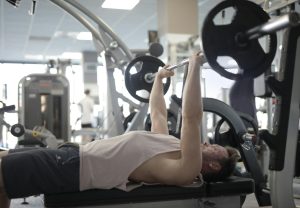
How to Perform
- Adjust the bench to a 30° incline.
- Lie back so your eyes align under the bar.
- Grip the bar slightly wider than shoulder-width.
- Lower the bar to just below your collarbone with control.
- Press it back up, extending your arms fully without locking elbows.
Pro Tip
Keep elbows at about 45° from your torso to reduce shoulder strain. Focus on a steady descent and explosive push.
Why It Works
The incline barbell press provides a stable base, allowing heavier loads than dumbbells while maintaining a consistent motion path. It’s ideal for progressive overload, the key driver of muscle growth.
Benefits
- Builds upper pec mass through high mechanical tension.
- Strengthens triceps and shoulders in supporting roles.
- Promotes postural balance by developing the upper front chain.
2. Incline Dumbbell Bench Press
The incline dumbbell press is an effective exercise for targeting the upper chest muscles and offers a deeper stretch and greater range of motion compared to the barbell version. Each arm works independently, promoting balanced muscle development and correcting strength asymmetries.
This exercise also requires more stabilizer engagement, particularly from the shoulders and core, improving joint control and functional strength.
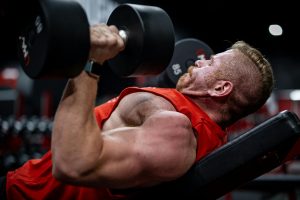
How to Perform
- Adjust your bench to a 30–45° incline.
- Hold dumbbells at shoulder height, palms forward.
- Press the weights upward until your arms are extended.
- Lower them slowly, maintaining tension through your chest.
Pro Tip
Pause briefly at the top to squeeze your pecs before lowering the dumbbells. The pause increases time under tension—a key factor in hypertrophy.
Why It Works
The freedom of movement with dumbbells allows your arms to follow a natural arc, minimizing joint stress and maximizing activation of the clavicular head.
Benefits
- Enhances symmetry and corrects strength imbalances.
- Increases muscle fiber recruitment due to independent arm movement.
- Improves shoulder stability, essential for safe upper body training.
3. Dumbbell Chest Fly
The dumbbell fly isolates the chest, emphasizing the stretch and contraction phases that lengthen and shorten muscle fibers. Performed on an incline, it becomes an excellent isolation move for the upper chest.
This movement also increases flexibility across the pectoral and anterior deltoid regions, improving range of motion for pressing movements.
How to Perform
- Set your bench to a 30° incline.
- With dumbbells held above your chest, palms facing each other, slightly bend your elbows.
- Lower the weights outward in a controlled arc until your upper arms are parallel to the floor.
- Bring the dumbbells back together in the same arc motion.
Pro Tip
Avoid lowering too deep—stopping just below shoulder level prevents strain. Keep tension constant throughout the movement.
Why It Works
The wide, arcing motion directly stretches the muscle fibers of the upper pecs, creating microtears necessary for muscle repair and growth. This controlled eccentric phase is crucial for hypertrophy.
Benefits
- Enhances definition and shape by isolating upper chest fibers.
- Improves flexibility and shoulder joint health.
- Complements compound movements by balancing muscle workload.
4. Dumbbell Pullover
The dumbbell pullover bridges chest and back training by engaging both the pectoralis major and the latissimus dorsi. It’s an excellent finisher for expanding the rib cage area and improving thoracic mobility.
Performed correctly, it builds strength through the chest and serratus anterior while opening up tight shoulders and improving shoulder mobility—a benefit supported by findings from Sports Biomechanics journal, which noted enhanced muscle activation in the anterior trunk during pullovers.
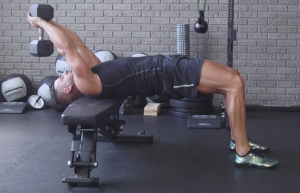
How to Perform
- Lie across a bench so your upper back and shoulders are supported, feet flat on the floor.
- Hold a single dumbbell with both hands over your chest.
- Lower it slowly in an arc behind your head until you feel a stretch across your chest.
- Bring it back to the start, engaging your pecs through the lift.
Pro Tip
Keep your hips steady and core tight. Let your chest—not your arms—control the motion.
Why It Works
The pullover trains the stretch-shortening cycle of the pectoral muscles while involving the lats, promoting balanced development and better breathing capacity.
Benefits
- Improves upper body flexibility and chest expansion.
- Targets multiple muscle groups, increasing efficiency.
- Supports shoulder health by encouraging a full range of motion.
5. Decline Push-Up
The decline push-up offers an accessible yet powerful option among bodyweight exercises that focuses on the upper chest through adjusted leverage. By elevating the feet, you mimic the angle of an incline press, directing effort toward the clavicular head.
This exercise can be modified for any skill level—using a step, bench, or stability ball—and still deliver effective muscle activation without equipment.
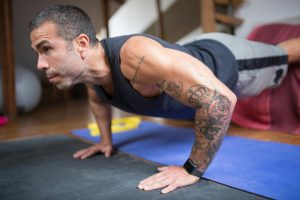
How to Perform
- Place your feet on an elevated surface and hands shoulder-width on the floor.
- Keep your body in a straight line from heels to head.
- Lower your chest slowly toward the ground.
- Push up until arms are fully extended.
Pro Tip
Focus on form over quantity. Controlled reps with correct alignment outperform rushed sets every time.
Why It Works
Adjusting the body angle redistributes weight toward the upper chest, increasing difficulty compared to standard push-ups while maintaining full-body engagement.
Benefits
- Strengthens the upper chest without needing equipment.
- Engages the core, promoting stability and endurance.
- Versatile and joint-friendly, perfect for home workouts or active recovery.
Benefits of Decline Push-Ups
The decline push-up is a fantastic exercise that strengthens the chest, front delts, and triceps, while also giving your core an extra challenge. Unlike regular push-ups, this variation increases difficulty by elevating your feet, which shifts more focus to the upper chest. Best of all, it requires no equipment, so you can do it anywhere.
- Strengthens the Upper Body Effectively: The decline push-up places extra tension on the chest, front delts, and triceps, helping build upper body strength. Elevating your feet makes it more challenging than regular push-ups, ensuring better muscle activation.
- Engages Core Muscles for Stability: Holding a plank position throughout the movement provides ab training, helping to improve core strength and endurance. This exercise offers a hidden bonus of engaging stabilizing muscles, making it an efficient full-body workout.
- No Equipment Needed—Train Anywhere: One of the biggest advantages of this exercise is that it can be performed anywhere without any equipment. Simply place your feet on an elevated surface, like a bench or step, and you have a highly effective chest-building movement.
Upper Chest Workout Rules to Quickly Grow Mass
Developing the upper chest demands more than effort; it calls for smart programming. These principles translate years of training insight into clear, applicable rules.
Prioritize Upper Chest Movements
The upper portion of the pectoralis major—the clavicular head—responds best to incline and upward-angled movements. Place these exercises first in your routine, when strength and energy are highest.
Performing incline bench presses, incline dumbbell presses, and cable crossovers at upward angles ensures the target fibers are recruited before fatigue shifts the load to the mid-chest. Consistency is key. Schedule two or three focused upper-chest sessions weekly, spacing them 72 hours apart for adequate recovery. Keep progression measurable: increase load, reps, or time under tension every few weeks. Proper form—especially controlled lowering—builds density while protecting the shoulder joint.
Do It Manually – Avoid Fixed Benches
Machines and fixed benches restrict the natural movement path of the shoulder girdle. Free-weight training allows stabilizer activation, enhancing neuromuscular coordination.
Adjustable benches let you fine-tune the incline to find the angle that engages your upper chest most effectively—usually between 30° and 45°. Manual control also builds proprioception, improving awareness of muscle engagement. The more you feel each repetition, the more effectively you can recruit specific fibers. This principle forms the basis of deliberate, mindful training.

Follow Up with Another Upper Chest Exercise
After a heavy compound lift, the muscle is primed for isolation. Adding a second exercise—such as an incline cable fly or reverse-grip bench press—extends the time under tension and fully exhausts the upper-chest fibers.
Combining angles and equipment keeps the stimulus varied, preventing plateaus. Pairing barbell work with dumbbells or cables targets the chest from multiple vectors, ensuring that smaller stabilizing fibers contribute to overall development. This “double-hit” approach is particularly effective for breaking stagnation in seasoned lifters.
Train the Upper Chest After a Rest Day
Recovery restores glycogen, balances hormones, and repairs microtears caused by resistance training. Hitting the upper chest the day after rest capitalizes on full energy stores and optimal nervous-system readiness.
This timing lets you lift heavier, maintain proper tempo, and sustain focus—factors that directly influence hypertrophy. A rest-day-first strategy also lowers injury risk; the shoulders and triceps are fresh, reducing compensation patterns that often occur when training in a fatigued state.
Add a Few Failure Sets
Failure training, when used judiciously, activates high-threshold motor units responsible for strength and growth. Finish your primary movements with one or two controlled sets taken to technical failure—meaning the last rep performed with proper form. This ultimately enhances muscle growth.
Examples include the final set of an incline dumbbell press or cable fly. However, avoid using this method on every exercise or training day. Overuse leads to fatigue and slower recovery. Reserve failure work for the end of a session to maximize intensity without compromising technique.
Tips for Effective Upper Chest Training
Even advanced lifters sometimes overlook simple fundamentals. These four principles refine execution and keep progress sustainable.
1. Progressive Overload
Muscles grow when gradually challenged beyond their accustomed workload. Apply progressive overload by increasing resistance 5–10 % every few sessions, slowing eccentric phases, or reducing rest intervals.
Alternate heavy strength blocks (4–6 reps) with hypertrophy blocks (8–12 reps) to stimulate different fiber types. Tracking every session builds accountability. Document sets, reps, and perceived exertion—data that guide future progression. Without measurable change, the body has no reason to adapt.
2. Focus on Form
Technique determines whether the upper chest or surrounding muscles bear the load. Keep wrists aligned, elbows at 45°, and shoulders retracted.
Use a full but safe range of motion; stop the bar just above the collarbone on incline presses and maintain slight elbow flexion during flies. A controlled pace—about two seconds down, one second up—maximizes muscle tension. Remember: good form turns effort into results; poor form turns effort into strain.
3. Use Supersets for Intensity
Supersets pair two movements with little rest, keeping the muscle under continuous stress.
Example: perform an incline bench press immediately followed by incline dumbbell flyes. This combination merges strength and isolation, flooding the muscle with nutrient-rich blood. Rest 60–90 seconds between supersets. The short recovery window elevates heart rate and boosts metabolic response while maintaining focus on the target area.
4. Maintain Balanced Training
A strong chest requires an equally strong back. Neglecting posterior-chain work can round shoulders and hinder pressing performance.
Integrate horizontal pulling (rows) and vertical pulling exercises (pull-ups, lat pulldowns) into the same weekly cycle. This counterbalances the pressing volume, supports posture, and stabilizes the shoulder complex. Balanced programming not only enhances appearance but also extends training longevity—healthy joints mean consistent progress.

Creating a Well-Rounded Upper Chest Workout Routine
Combining these methods into a structured schedule maximizes results and creates a comprehensive workout for your upper chest. Here’s an expanded weekly example that balances workload, recovery, and variety.
Weekly Split Example
Day 1: Upper Chest Focus with Compound and Isolation Movements
Start the week by engaging the clavicular head through multi-angle stimulation. Begin with the incline barbell bench press (4 sets × 6–8 reps) for heavy strength work, followed by incline dumbbell flyes (3 sets × 10–12 reps) to emphasize stretch and contraction. This enhances overall chest development.
Finish with dumbbell pullovers (3 sets × 12–15 reps) to open the chest cavity and enhance mobility. Maintain a 60-second rest between isolation movements to increase metabolic stress.
Day 2: Active Recovery or Light Cardio to Enhance Circulation
Low-intensity cardio, mobility drills, or yoga keep blood flowing to healing muscles. Activities like brisk walking, cycling, or foam rolling accelerate nutrient delivery and waste removal.
Focus on breathing and posture; gentle movement promotes recovery without imposing mechanical load.
Day 3: Lower Chest and Triceps for Symmetry
Perform decline bench presses, chest dips, and close-grip push-ups. These strengthen the sternal head and arm extensors, ensuring balanced development across the entire pectoral region.
Finish with triceps rope extensions or skull crushers to reinforce pressing stability and lockout strength.
Day 4: Back and Biceps to Balance Upper Body Strength
Include pull-ups, barbell rows, and seated cable rows to counteract pressing volume. Follow with bicep curls for arm proportion.
Balanced pulling builds scapular control, which is vital for safe and efficient chest pressing.
Day 5: Comprehensive Chest Session Covering All Angles
Combine flat barbell presses, incline dumbbell presses, and cable crossovers to engage the chest’s full range.
This mixed-angle session enhances overall density and corrects any weak points left by earlier isolation days.
Day 6: Shoulders and Core for Stability
Perform overhead presses, lateral raises, and face pulls to fortify the deltoids and rotator cuff.
Add planks, hanging leg raises, and ab-wheel rollouts to strengthen the midline—essential for bracing during heavy lifts.
Day 7: Complete Rest or Gentle Active Recovery
Use this day for stretching, swimming, or a slow walk. Quality rest restores the nervous system and prepares you for the next cycle.
Adequate hydration and nutrition—particularly lean protein and complex carbohydrates—support recovery and muscle repair.
How Often Should You Train the Upper Chest?
Most individuals benefit from one to two dedicated upper-chest sessions per week. Beginners should start with a single session emphasizing technique; intermediate and advanced lifters can progress to two, provided recovery markers—sleep quality, soreness, performance—remain positive.
Monitor how your body responds. If persistent fatigue or plateau occurs, reduce frequency temporarily and prioritize rest, nutrition, and mobility work. Remember: muscles grow between workouts, not during them.
Proper recovery includes protein intake of roughly 1.6–2.2 g per kg of body weight daily, 7–9 hours of sleep, and adequate hydration. These physiological basics underpin all training success.
Key Takeaway: Building a Stronger, Balanced Upper Chest
Targeted, consistent effort develops the upper chest into a powerful, aesthetic highlight of the physique. Prioritize incline-angle pressing, maintain impeccable form, and apply progressive overload. Support every workout with balanced nutrition and sufficient recovery.
By understanding anatomy, controlling tempo, and respecting recovery, you transform simple exercises into a strategic program. Over time, these deliberate habits deliver what every lifter seeks—a chest that is strong, defined, and harmoniously built.
Frequently Asked Questions
What Are the Best Upper Chest Exercises?
The best exercises for targeting the upper chest include the incline bench press (barbell or dumbbell), incline dumbbell flys, and incline cable flys. Incorporating resistance bands and incline push-ups can also be effective for home workouts.
Why Is My Upper Chest Not Growing?
Lack of growth in the upper chest is often due to neglecting incline movements, improper form, insufficient training volume, or poor recovery practices. Adding progressive overload, focusing on form, and ensuring a proper diet rich in protein can help.
How Do I Target My Upper Chest at Home Without Equipment?
You can target the upper chest at home using bodyweight exercises like incline push-ups (feet elevated), pike push-ups, and decline push-ups. Adding resistance bands for incline flys and presses can further enhance results.
What Is the Ideal Incline Angle for Upper Chest Workouts?
The ideal incline angle for upper chest workouts is between 30 and 45 degrees. A higher angle may shift focus to the shoulders, while a lower angle may target the middle chest instead of the upper region.
How Do I Target My Upper Chest at Home Without Equipment?
You can target the upper chest at home using bodyweight exercises like incline push-ups (feet elevated), pike push-ups, and decline push-ups. Adding resistance bands for incline flys and presses can further enhance results.
Can I Build My Upper Chest Without a Bench?
Yes, you can build your upper chest without a bench by using incline push-ups, resistance band presses, and creative setups like using a sturdy elevated surface for incline work. Dumbbell floor presses at a slight angle can also help.
Are Push-Ups Effective for the Upper Chest?
Yes, push-ups can be effective, especially incline push-ups where your feet are lower than your upper body. This angle emphasizes the upper chest while engaging supporting muscles.
How Long Does It Take to See Results in the Upper Chest?
Results vary depending on training intensity, consistency, and diet. Generally, with a proper upper chest workout plan and recovery, visible improvements can be seen within 4-6 weeks.
What Are the Benefits of Training the Upper Chest?
Training the upper chest improves overall chest aesthetics, posture, and upper body strength. It also helps balance muscle development, reducing the risk of injury caused by underdeveloped upper pectoral muscles.
What’s the Difference Between Flat Bench and Incline Bench for Chest Development?
The flat bench press primarily targets the middle and lower parts of the chest, while the incline bench press focuses on the upper portion of the pectoral muscles. For a well-rounded chest, both exercises should be included in your routine.
How Should I Warm Up Before an Upper Chest Workout?
A proper warm-up for the upper chest includes dynamic stretches (e.g., arm circles, chest openers) and light activation exercises like incline push-ups or resistance band flys. Gradually increase weight during your first incline bench press sets to prevent injury.
2 Comments